Overview
Transforming complex support journeys into intuitive self-service.
Led conversation design for TSB Business Banking — designing conversational flows, chatbot interactions, and guided customer journeys that reduced effort, improved clarity, and helped customers complete banking tasks with confidence.
The Problem
Business customers couldn't find answers without calling — and calls were expensive.
TSB's business banking customers faced complex, high-stakes queries — account management, payment queries, fraud concerns — that the existing digital support couldn't handle. Call volumes were high, and the chatbot that existed gave generic responses that eroded trust.
What I Did
Research & intent mapping
Analysed call transcripts and chat logs to identify the top business banking intents. Ran workshops with frontline agents to understand the nuance behind each query — what customers actually meant vs. what they said.
Conversation & flow design
Designed end-to-end conversation flows in IBM Watson Assistant — from opening intents through to resolution or warm handoff. Wrote dialogue that balanced confidence with appropriate caution for financial queries.
Support Journey
Mapping friction to rebuild confidence.
I mapped the end-to-end support journey from issue to resolution — capturing what customers did, thought, and felt at each stage — to find where effort, uncertainty, and drop-off occurred, and where conversation design could rebuild confidence.
Wireframes
Shaping conversation flows with wireframes.
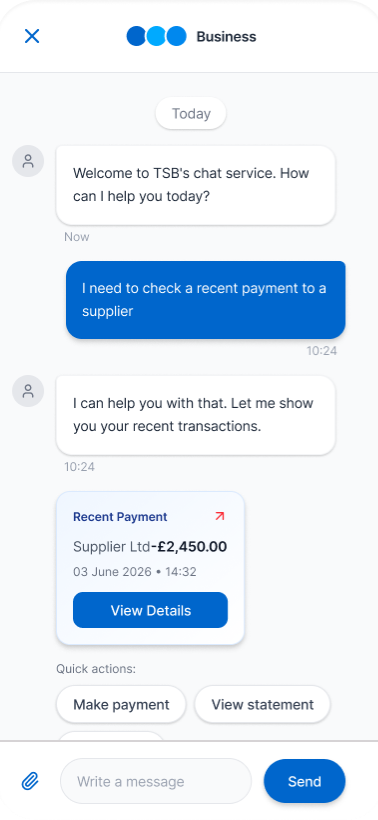
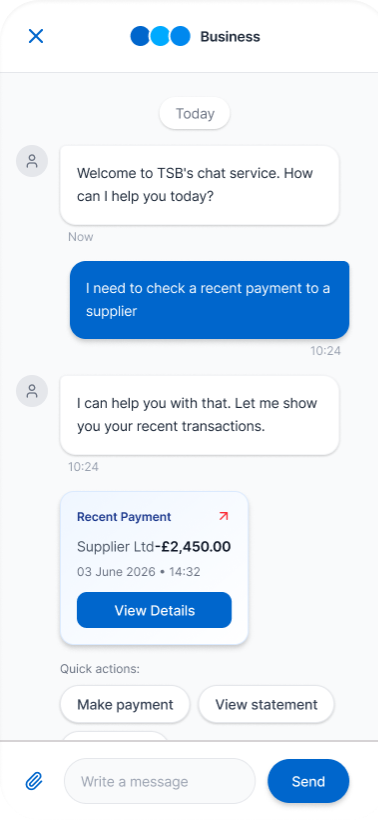
I translated the conversation flows into high-fidelity wireframes in Adobe XD to test interaction patterns and pressure-test the visual design — focusing on structure, key decision moments, content hierarchy, and how customers move through different support journeys.
I explored ways to present information and capture input — prompts, quick replies, confirmation screens, escalation paths, and error recovery. The goal was natural, intuitive conversations with low effort for common banking tasks.
I reviewed the wireframes with stakeholders, product owners, and technical teams to validate requirements and improve the experience. Over several iterations, I simplified decision points, removed unnecessary steps, and clarified prompts and guidance — giving us alignment across business, user, and technical needs, and a clear blueprint that reduced rework in the build phase.
Outcome